25 most asked questions on Closed-Containment Aquaculture
FAQ for Aquafarm Equipment and Closed-Containment fish Farming
Aquafarm Equipment develops modular closed-containment systems for controlled fish production globally.
As the global salmon and fish industry faces increasing pressure from sea lice, escapes, biological risk and environmental expectations, closed containment offers a practical path toward more predictable and responsible production.
This FAQ answers common questions about closed-containment aquaculture, escape prevention, lice reduction, water quality, modular scaling and Aquafarm Equipment’s role in the future of salmon farming.
1. What does Aquafarm Equipment provide?
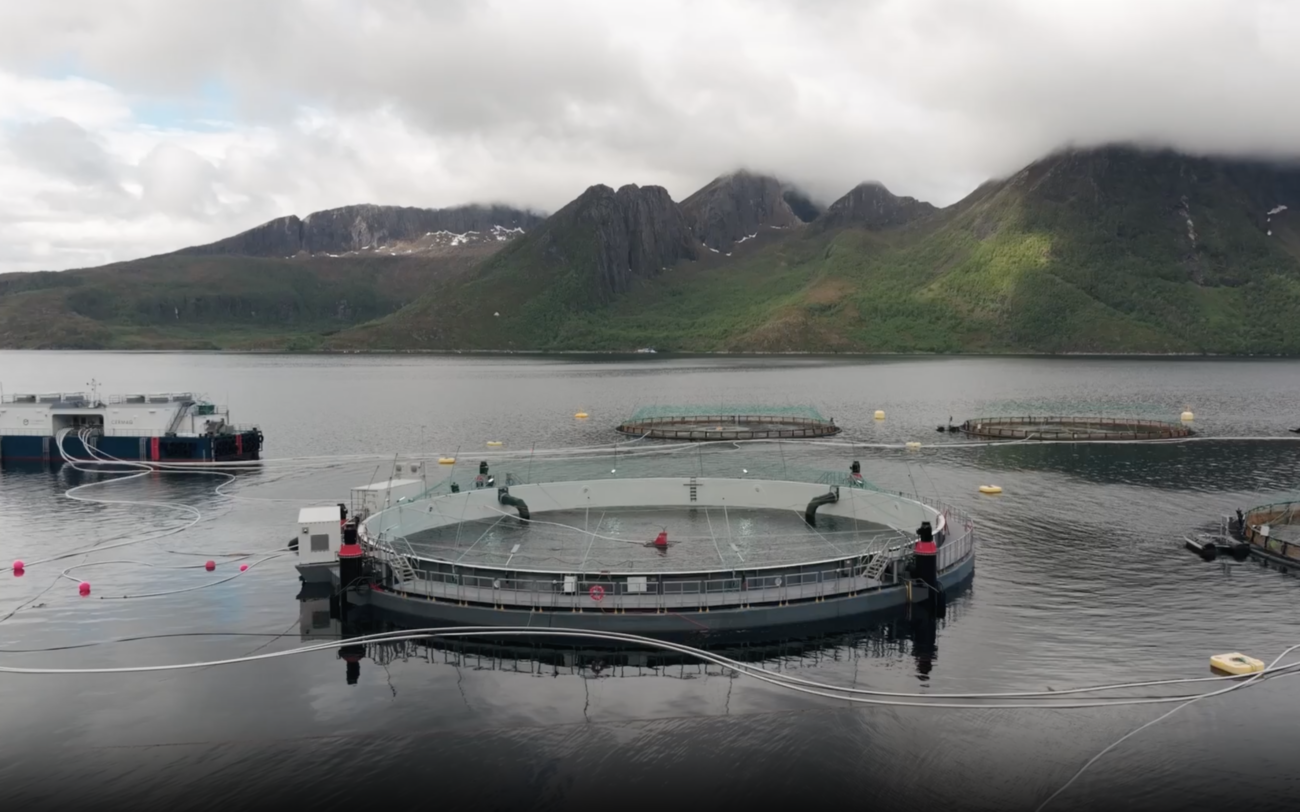
Aquafarm Equipment provides modular closed-containment systems for fish farming at sea. The systems are designed to give farmers better control over biological conditions, water quality, escape prevention and lice exposure while keeping production in a marine environment.
2. What is closed-containment aquaculture?
Closed-containment aquaculture uses a physical barrier to separate farmed fish from the surrounding marine environment. This helps reduce exposure to external biological risks such as sea lice, parasites and disease pressure, while also helping prevent fish from escaping into the wild.
Independent field trials also show that fish in closed-containment systems can reach market weight faster, with lower mortality, than equivalent fish in open pens. Control is a growth advantage, not only a risk-reduction measure.
3. How is closed containment different from traditional open-net farming?
In traditional open-net farming, fish are directly exposed to the surrounding sea. In closed-containment farming, the fish are held inside a closed structure where water intake, water flow and environmental conditions can be managed more actively.
The key difference is control.
4. Why is control becoming so important in fish farming?
The global fish industry faces increasing pressure related to sea lice, escapes, fish welfare, mortality, environmental performance, regulations and public trust. More control helps farmers reduce risk, improve predictability and support more responsible growth.
5. How does Aquafarm Equipment help prevent escapes?
Aquafarm Equipment’s closed-containment systems create a physical barrier between the fish and the surrounding environment. All inlets and outlets are fitted with double barriers, using a patented hatch system that also helps maintain strong water flow through the tank. This means escape prevention is built into the system design itself — rather than relying solely on nets, procedures, and manual follow-up.
6. Why are escapes such a major issue?
Escapes can result in production loss, environmental impact, reputational damage and regulatory consequences. In many markets, escape prevention is now closely linked to the industry’s social licence to operate.
7. How does closed containment prevent sea lice?
Closed-containment systems physically separate the fish from external lice pressure. By controlling water intake depth and reducing exposure to the upper water layers where lice are often most concentrated, the system helps prevent lice from reaching the fish.
8. Does this mean lice treatments can be reduced?
The goal of closed containment is to reduce or eliminate lice exposure before treatment becomes necessary. No lice pressure will eliminate the need for handling, treatment and related stress on the fish.
9. Why is water quality so important?
Water quality directly affects fish welfare, growth and biological performance. Oxygen, CO₂, temperature, water flow and water exchange are all critical factors. Better water control gives farmers a stronger foundation for predictable production.
10. What does “control the water, control the biology” mean?
It means that biological performance is closely linked to the environment inside the production unit. When farmers can monitor and manage water conditions more effectively, they can also manage fish health, welfare and growth more predictably.
11. What is the benefit of a modular system?
A modular system allows the design to be easily adapted to each farmers needs, as well as to ongoing regulatory changes and requirements. Rather than being locked into a fixed configuration, the system can be adjusted and reconfigured as conditions, needs, or regulations evolve.
12. Why is modularity important for international markets?
Every farming region has different site conditions, regulations, biological challenges and investment needs. A modular system can be adapted to local strategies and scaled according to market requirements.
13. What production phases can closed containment support?
Closed-containment systems can support different production strategies, including, post-smolt and grow-out phases, depending on site conditions, production goals and system configuration.
14. Why Is closed containment an alternative to land-based farming?
Closed containment at sea can be seen as a practical and more cost-effective alternative or complement to land-based farming. It allows producers to gain more control while still using marine locations and sea-based farming infrastructure.
15. Why Is closed containment an alternative to offshore farming?
Closed containment and offshore farming solve different challenges. Offshore farming moves production to more exposed areas, while closed containment focuses on controlling biological and environmental risk at sea. For many producers, closed containment may be a more practical step toward lower-risk production.
16. Why does Aquafarm Equipment use GRP?
GRP, or glass reinforced plastic, is strong, lightweight, durable and resistant to corrosion. It is suitable for demanding marine environments and supports robust, long-term closed-containment structures.
17. Why does material choice matter?
Closed-containment systems must operate reliably in challenging marine conditions. Material choice affects durability, maintenance, structural stability and long-term investment confidence. A closed system needs more than a barrier — it needs a marine structure built to last.
18. How does Aquafarm Equipment support sustainability?
Aquafarm Equipment supports sustainability by helping farmers prevent escapes, reduce lice exposure, improve fish welfare, manage water quality and lower biological risk. These factors can contribute to more responsible and better-documented production.
19. Which international markets are most relevant for this technology?
Closed-containment technology is relevant in markets where fish producers face pressure related to lice, escapes, mortality, environmental performance, regulation or social licence. This includes Norway, Scotland, Canada, Chile, Iceland, the Faroe Islands and other fish farming regions.
20. What makes Aquafarm Equipment different?
Aquafarm Equipment helps fish farmers produce fish safely at sea, using closed-containment technology. Their systems combine modular design, durable GRP materials, and water quality control — all backed by deep experience in Norwegian aquaculture. This helps farmers lower risk and grow their operations with confidence.
21. Does closed containment actually improve growth, or only reduce risk?
Independent benchmark trials show faster growth to market weight in closed-containment systems. Accumulated mortality stayed below 2.5 percent, outperforming open-pen control groups in the same trials. Controlling water quality, oxygen and biological exposure appears to support both welfare and performance.
22. Are regulators starting to reward closed containment?
Yes, in some markets. In Norway, producers in sea lice “red” zones can now regain lost production capacity by farming in closed systems that meet strict environmental requirements. This marks a shift. Regulation used to only restrict open production. Now it actively rewards demonstrated control.
23. Why does construction material matter as much as “closed vs. open”?
As more producers adopt closed and semi-closed technology, the designs on the market differ significantly. Some use flexible, water-pressurised polymer barriers. Others use large standardized floating structures. Aquafarm Equipment builds its modular systems in GRP, glass reinforced plastic, chosen for strength, corrosion resistance and long structural lifespan in demanding marine conditions. Aquafarmen, the company’s unit in Hamarøy, Norway, has been operating through repeated coastal winters. Real-world evidence, not just laboratory testing. Material and structural choice is what determines whether a closed system keeps performing years after installation, not only when delivered.
24. Is closed containment risk-free for fish welfare?
No, and Aquafarm Equipment is direct about that. “You have clear upsides, but there are downsides too,” says CEO Trond Haldorsen. “You close the fish in, so if disease or parasites get inside, they don’t disperse as quickly as they might in open water.” The trade-off is full environmental control. Operators can monitor and manage oxygen, water exchange, flow and CO2 levels precisely. That’s not possible in an open pen. Closed containment doesn’t remove every risk. It replaces uncontrollable risks with controllable ones.
25. How long has Aquafarm Equipment’s technology been proven in the field?
Fifteen years. The company’s earlier-generation Neptun-class system has been in continuous operation for Mowi at Vinsvik, Norway, for fifteen years. That is fifteen years of uninterrupted production data: zero escapes, no lice able to establish, minimal mortality, and consistently faster growth than open pens. It is the longest documented closed-containment track record in the industry.
Explore modular closed-containment systems for scalable fish production at sea.